Operations → Cloud Infrastructure
Edge Computing
Running computation closer to users, devices, or data sources to reduce latency or bandwidth.
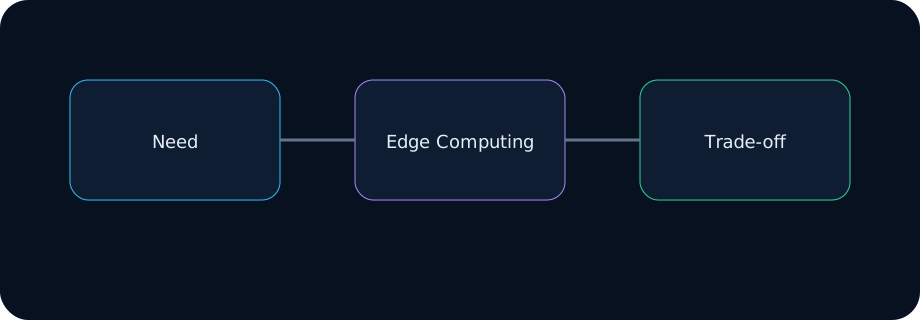
Motivation
Edge Computing exists because teams need a practical way to solve a recurring problem in real systems. It gives engineers a shared abstraction for discussing trade-offs instead of treating every implementation as unique.
Where it fits
Edge Computing belongs to the operations track in the cloud infrastructure layer. It is useful when reasoning about nearby concepts such as Serverless.
Mental model
Think of Edge Computing as a named design pressure: it usually improves one quality, such as scalability, safety, usability, or operability, while adding constraints that must be understood.
Example in practice
When Edge Computing appears in a system, the important question is not only what it is, but why the system needs it and what failure modes it introduces.
Common mistakes
- Using Edge Computing because it is fashionable rather than because the problem requires it.
- Ignoring the operational cost or learning curve.
- Treating the concept as isolated instead of connecting it to neighboring concepts.