Software → System Design
SPOF
A component, dependency, or process whose failure can bring down an entire system or critical user flow.
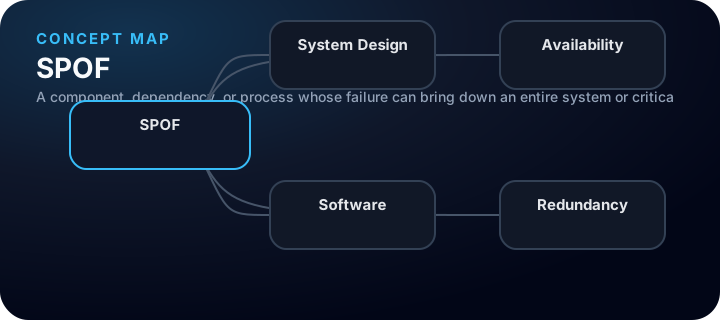
Where it fits
SPOF stands for Single Point of Failure. It is a system-design risk: one server, database, queue, DNS dependency, team-owned process, or manual approval that can stop the whole service when it fails.
Mental model
A system is only as available as the weakest required dependency in its request path. If every successful request must pass through one component, that component can become a SPOF.
Example
A backend service may run behind many application servers, but still depend on one primary database instance. If that database has no replica or failover plan, the database is a Single Point of Failure.
How engineers reduce it
Use redundancy, failover, health checks, backups, multi-zone deployment, graceful degradation, and operational runbooks. The goal is not to duplicate everything blindly; it is to identify the dependencies whose failure breaks the most important flows.
Common mistakes
- Treating redundancy as automatic resilience without testing failover.
- Missing non-technical SPOFs such as one person owning a deployment key or manual recovery process.
- Removing one SPOF while creating another, such as placing all traffic behind one unprotected proxy.
Related concepts
Availability, redundancy, failover, load balancing, bottleneck, reliability, and disaster recovery.