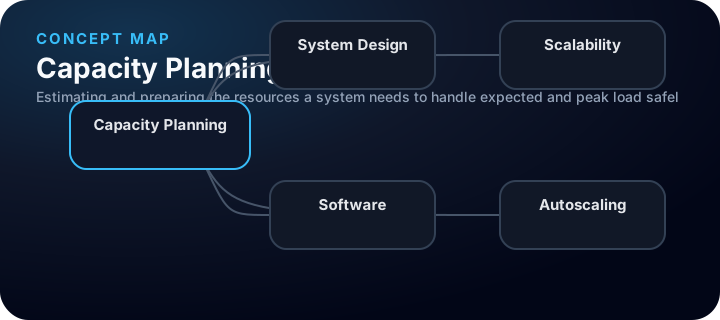
Software → System Design
Capacity Planning
Estimating and preparing the resources a system needs to handle expected and peak load safely.
Where it fits
Capacity planning connects system design, traffic forecasts, infrastructure cost, and reliability. It asks whether the system has enough compute, storage, network, queue, and database capacity for normal and peak demand.
Mental model
Capacity is a budget. Every request spends some CPU, memory, I/O, network, database, and human operational attention. Capacity planning estimates those budgets before users discover the limits for you.
Example
Before a launch, a team estimates peak requests per second, database write volume, cache hit rate, queue backlog tolerance, and rollback capacity. That planning determines whether to scale horizontally, increase limits, add caching, or simplify the launch.
Common mistakes
- Planning only for average load instead of peak load.
- Forgetting downstream dependencies and quotas.
- Treating autoscaling as a substitute for understanding bottlenecks.
Related concepts
Scalability, bottleneck, autoscaling, latency, observability, and load testing.
Capacity Planning Document
A maintained artifact recording workload assumptions, growth forecasts, bottlenecks, resource models, safety margins, and scaling decisions.
Foundation guide
See SLI, SLO & SLA Foundations for a detailed explanation of service indicators, objectives, agreements, error budgets, metric categories, and production-style examples.